





Willis Knighton Health First in Region to Offer NanoKnife® Surgery for Prostate Cancer
September 24, 2026
Patients with inoperable or advanced prostate cancer now have an innovative, late-stage therapy that offers effective cancer control and quality-of-life preservation.
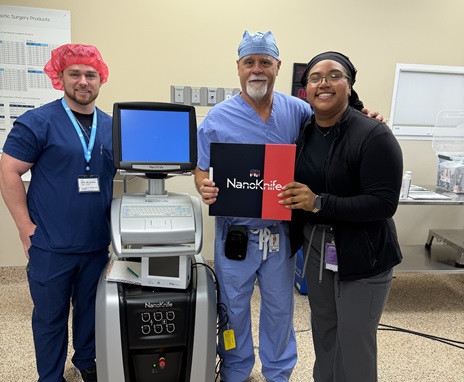
NanoKnife® is a minimally invasive focal therapy used to destroy targeted areas of abnormal tissue using a process called irreversible electroporation, or IRE. Urologic oncologist David Price, MD, of Willis Knighton Urologic Oncology Pierremont, is the first in the region to use NanoKnife® for prostate cancer.
IRE uses short targeted electrical pulses to create permanent microscopic holes in the outer membranes of diseased cells, destroying them. Unlike many traditional ablation treatments that use very high heat or extreme cold to destroy tumors, the NanoKnife®’s use of electrical energy precisely targets the tumor and potentially limits injury to the structures responsible for urinary control and sexual function.
“NanoKnife® gives us another way to individualize the treatment of prostate cancer. For the properly selected patient, our goal is no longer simply to treat the cancer; it is to treat the cancer effectively while preserving as much normal anatomy and function as possible,” Dr. Price says.
The minimally invasive procedure – there are no abdominal incisions – takes between 60 and 90 minutes depending on the size, location and number of areas being treated. Most patients go home the same day and return to routine activities relatively quickly.
“For Willis-Knighton Health, bringing NanoKnife® to our patients represents another important step toward providing a comprehensive prostate cancer program here in North Louisiana,” Dr. Price says. “Patients should not have to leave this region to have access to sophisticated focal therapy, advanced robotic surgery or modern clinical trials. Our objective is to offer the full spectrum of prostate cancer treatment so that we can match the treatment to the patient and the biology of his cancer—not force every patient into the same treatment.”
Share


Willis Knighton Health First in Region to Offer NanoKnife® Surgery for Prostate Cancer
September 24, 2026
Patients with inoperable or advanced prostate cancer now have an innovative, late-stage therapy that offers effective cancer control and quality-of-life preservation.
NanoKnife® is a minimally invasive focal therapy used to destroy targeted areas of abnormal tissue using a process called irreversible electroporation, or IRE. Urologic oncologist David Price, MD, of Willis Knighton Urologic Oncology Pierremont, is the first in the region to use NanoKnife® for prostate cancer.
IRE uses short targeted electrical pulses to create permanent microscopic holes in the outer membranes of diseased cells, destroying them. Unlike many traditional ablation treatments that use very high heat or extreme cold to destroy tumors, the NanoKnife®’s use of electrical energy precisely targets the tumor and potentially limits injury to the structures responsible for urinary control and sexual function.
“NanoKnife® gives us another way to individualize the treatment of prostate cancer. For the properly selected patient, our goal is no longer simply to treat the cancer; it is to treat the cancer effectively while preserving as much normal anatomy and function as possible,” Dr. Price says.
The minimally invasive procedure – there are no abdominal incisions – takes between 60 and 90 minutes depending on the size, location and number of areas being treated. Most patients go home the same day and return to routine activities relatively quickly.
“For Willis-Knighton Health, bringing NanoKnife® to our patients represents another important step toward providing a comprehensive prostate cancer program here in North Louisiana,” Dr. Price says. “Patients should not have to leave this region to have access to sophisticated focal therapy, advanced robotic surgery or modern clinical trials. Our objective is to offer the full spectrum of prostate cancer treatment so that we can match the treatment to the patient and the biology of his cancer—not force every patient into the same treatment.”
Share